Monday, June 4, 2012

Hamsters!!!!

2 pt. special!!!


As you can see, hamsters are very cute, in fact they are one of the most common
pets because of it. I know that there are many more reasons that hamsters are popular, but specials are pretty much a little bit of info and a lot of cute pictures so I'll just tell you the basic information and then I'll show you cute pictures of hamsters.hamsters are cute, cuddly, and they love to lick your fingers. 

Now,


Monday, December 27, 2010

Penguins

Penguins are small birds, but they cannot fly. The biggest penguins are Emperor penguins. Emperor penguins can get 4 ft tall. The Emperors are black birds with white and yellow markings. Other penguins are black birds but they only have white markings. They don't have wings - they are called "flippers", and flippers help them swim. Some penguins like the Adelie penguins can go up to 40 or even 100 miles per hour, while a few others are a bit faster. 15 miles per hour or higher depends on the penguin species.

Emperors also have the largest eggs among penguins. They can be 120mm long and 85 mm wide and weigh about 450 grams.

Almost every penguin puts their eggs on top of their feet so the eggs stay warm. When the chick hatches - the mother arrives. It has a nice barf dinner, awaiting the baby. It may sound gross, but it's not to the penguins.


Friday, March 13, 2009

Eagles

Eagles eat mice and berries. Bald eagles eat fish, turtles, small rodents and snakes. They catch fishes with downward looking eyes like catfish because they catch them by snatching them off the surface. 

Bald eagles hunt by waiting on a perch until the see the food. They can see a surfacing fish from a mile away.

Saturday, January 17, 2009

The Fish


I wanted to find out what was inside the fish and what the brain looked like. We went to a supermarket and bought a fish. The name of this fish was Bass. He was a beautiful fish. He was gray and green on the top and white on the bottom. He had stripes along his body.


He had two fins onthe top of his back. He also had two fins on the sides behind his gills, two fins on the bottom and one fin near the tail. Some goldfish have two tails but this one had only one.


In his mouth he had teeth which are very small, but there are a lt of them and a tongue. I knew fishes had tongues because I know of that shrimp that gets inside a fish an sucks the blood out its tongue and it replaces the tongue with itself and serves as its new tongue. This is very strange. But it is not about this fish.


Behind the covers on the sides of its head there are its gills. He uses gills for breathing. The fish opens and closes the covers to pump water through them. But sharks can't. So they have to always keep swimming so that they can breathe.


Then we cut the fish open. I didn't know this but there were only a few things inside the fish. They were intestines, stomach, heart, liver and gonads. There was also kidneys but they were small. And there was a swimbladder. And also pyloric caeca. And spine.


This is the fish's heart. It was small. It was hiding between its head and liver. It had the blood in it.


This is the stomach, pyloric caeca and intestines all in one pile. They were hard to separate. We opened the stomach and found there a half-digested worm.


This is a picture of the liver. It makes enzymes that help digestion. Enzymes are chemicals that help chemical reactions in the body. Enzymes break down food and turn it into energy. Livers also cleans up the body by filtering the junk out of blood. 


These are the gonads.


Gills.

Friday, December 26, 2008

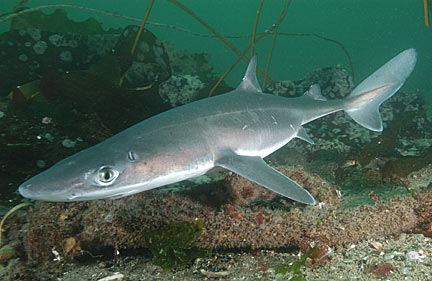
Spiny Dogfish


Spiny dogfish, also known as Mud Shark, Piked Dogfish, Skittledog, Spotted Dogfish, White-spotted Dogfish, Codshark, Thorndog, and Squalus acanthias (in Latin) lives in Atlantic and Pacific Oceans on both sides of North America.

The spiny dogfish/mud shark has dorsal spines, located in front of its two dorsal fins, no anal fin, and white spots along its back.
If the mud shark is captured, it can arch its back to pierce the attacker with its two dorsal spines. The spines are mildly poisonous. The venom of the shark is held in the tissue which is embedded in the groove along the spine. The poisonous sting can be very painful for humans. Their sting might even be lethal, but it is not yet confirmed.

Mud sharks have the longest gestation period among all vertebrates. About 2 to 11 pups are in each litter.

Mud sharks live from 25 to 100 years.


Saturday, December 20, 2008

Crabs

Crabs are Crustaceans. Crustaceans don't have backbones and wear their skeletons on the outside. This group includes 52000 species - lobsters (which are bugs), barnacles and crabs. They live on land and in the water. But most - in the water. Once I ate a crab and found cartilage inside the claw. 

Some crabs put sea anemones on their backs to protect themselves from octopuses. Some anemones eat crabs, like this one in the picture from National Geographic.


This is a Ghost Crab. They have this name because they can appear and disappear very fast - jumping in and out of their sandholes.


Tuesday, December 16, 2008

Platypus


Platypus is a mammal that lays eggs. It has webbed feet. Platypus lives in Australia. It is venomous. It has a duck bill, otter feet and beaver tail. The male platypus has a spur on the hind foot that can deliver the venom and cause pain to humans. An Australian 20 cent coin has an image of a platypus.


We live in Arlington - we cannot get a platypus as a pet. Platypus is a carnivore. It eats shrimp and worms, like that one on the left (anelid worm). Every day the platypus needs to eat one fifth of his weight in food.


This picture on the right is the platypus’ foot with the venomous spur. Platypus does not make a good pet because it has a venomous spur, it eats a lot and its poop smells. When animals flex their muscles they send electric signals.That’s how the platypus finds its prey. It is called “electrolocation”. Platypus find its food by digging with its bill at the bottom of streams where he dives. It swims only by its front feet. And it uses its rear feet to steer.


This is two platypus eggs and an Australian 20 cent coin. They are very small. In the picture down below - these little platipi are young. They just hatched.